Radio signatures of star–planet interactions, exoplanets and space weather
1. Introduction & Motivation
The Problem: Understanding the space environment around exoplanets is crucial for characterizing their potential habitability. This requires measuring stellar magnetic activity and space weather events (like CMEs).
The Limitation of Other Wavelengths: X-ray and UV observations tell us about the star’s atmosphere, but radio detections offer a unique, sensitive window onto the star’s magnetosphere and the exoplanet’s own magnetic field and its interaction with the star.
The Paper’s Role: This paper is a primer designed to guide new researchers, detailing the physical mechanisms and recent observational advances in the field.
-
- radio free–free emission from the ionized coronal winds
- X-ray emission generated by charge exchange between the ionized wind and interstellar neutrals
- astrospheric Lyα absorption and absorption from the hydrogen wall
- bursty, low-frequency radio accompanying the CME
-
- auroral (radio) emission
Key Questions
- How can radio bursts (like those from the Sun) characterize stellar space weather and detect stellar CMEs?
- What is the role of magnetic Star-Planet Interaction (SPI) in producing observable radio signals?
- Can we directly detect the radio emission from an exoplanetary magnetosphere (like Jupiter’s aurora) and use it to measure the planet’s magnetic field?
2. Key Concepts & Mechanisms (The “How?”)
A. Radio Emission Mechanisms
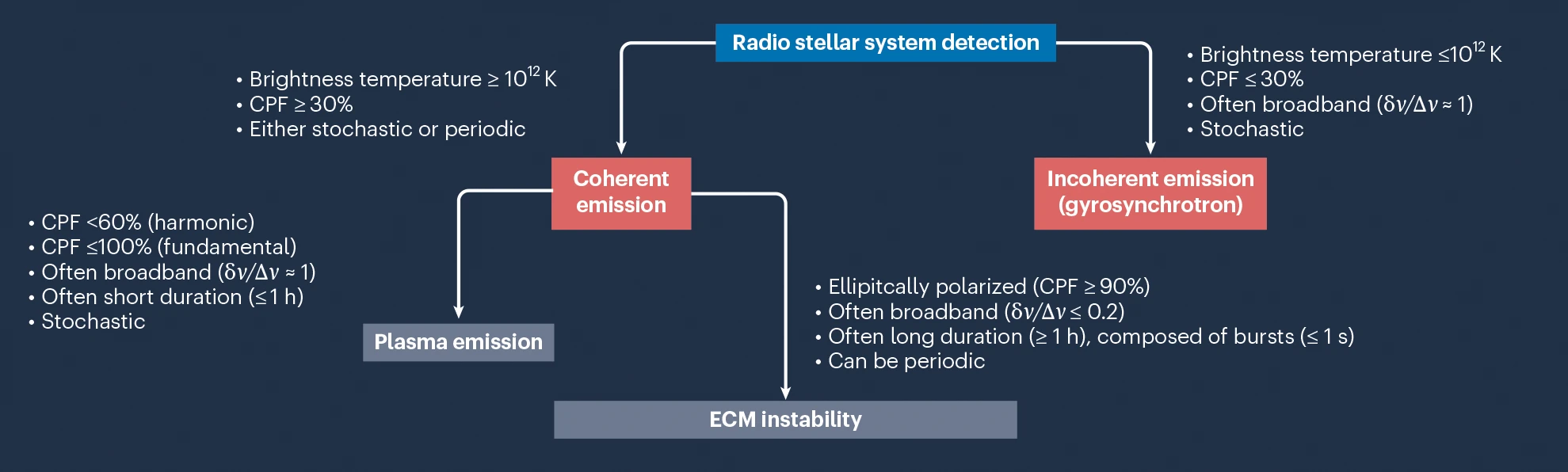
Two main types of radio emission in stellar systems:
| Type | Mechanism | Physics | Significance |
|---|---|---|---|
| Incoherent | Gyrosynchrotron Emission | Generated by mildly-relativistic electrons spiraling in a magnetic field. | Associated with flares and active regions on the star. |
| Coherent | Electron Cyclotron Maser Instability (ECMI) | Generated by energetic electrons trapped in a magnetic field. All electrons emit in phase, resulting in extremely bright radiation. | This is the mechanism for stellar auroral emission, planetary auroral emission, and Star-Planet Interaction signatures. |
B. Solar System Analogues
The paper emphasizes using the Sun and Jupiter as templates:
- Solar Bursts:
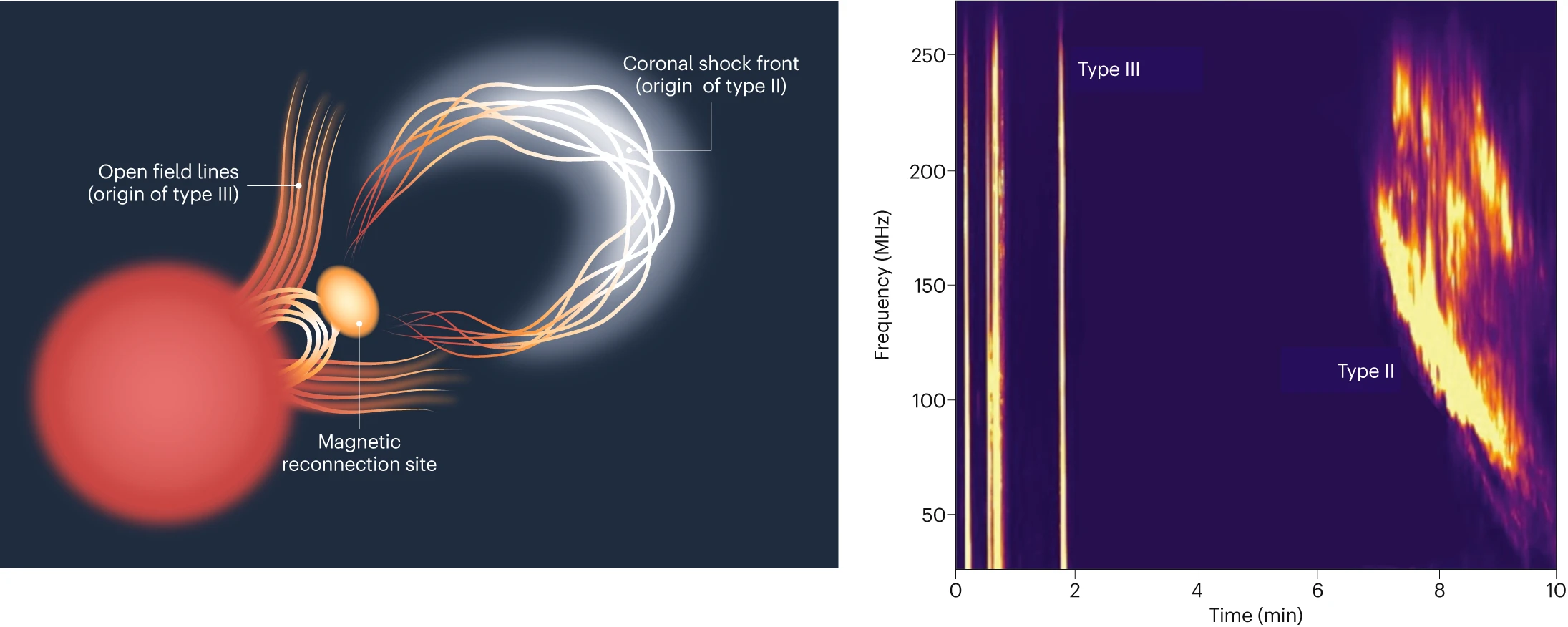
- Type II Bursts (minutes to hours) are associated with electrons accelerated by CME shocks. Detecting these in exoplanetary systems is the best way to characterize CMEs.
- Type III Bursts (short, seconds) are associated with electron beams from magnetic reconnection events.
- Jupiter’s Aurorae: The powerful, highly directional radio emission from Jupiter’s magnetic poles is the direct analogue for potential exoplanet auroral radio emission.
3. Observational Advances & Key Results (The “What?”)
A. Star-Planet Interactions (SPI)
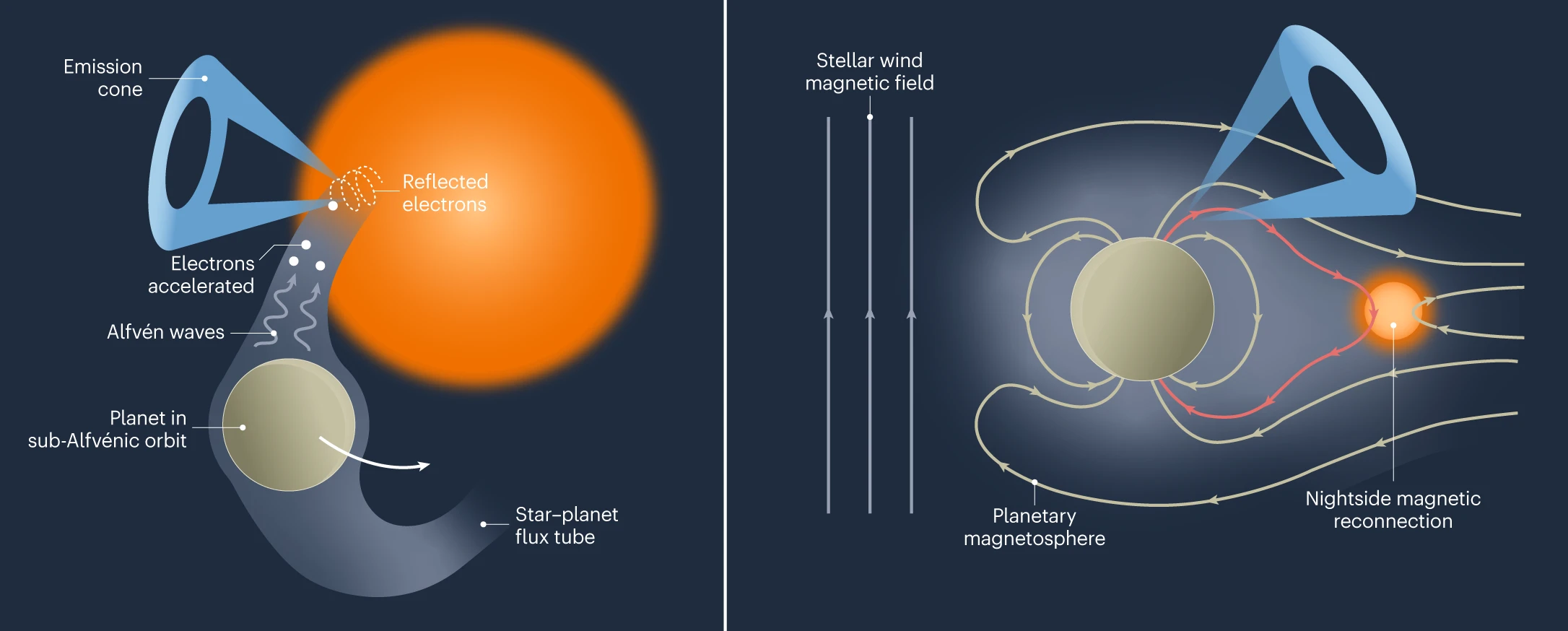
- Concept: When a close-in planet orbits within the star’s magnetosphere, the planetary and stellar magnetic fields can connect and accelerate electrons toward the stellar/planetary poles.
- Signature: This magnetic connection is predicted to generate bright, coherent radio bursts that are modulated (or synchronized) with the planet’s orbital period.
- Status: The paper reviews recent provisional detections of these SPI-induced radio bursts, highlighting their potential for characterizing exoplanet systems and their magnetic fields.
B. Direct Exoplanet Magnetosphere Detection
- Goal: To detect the radio aurorae generated by the exoplanet itself (ECMI emission).
- Significance: Detecting a planet’s magnetic field is crucial for determining its ability to shield its atmosphere from harsh stellar wind—a key factor for long-term habitability.
- Status: There are early tentative results hinting at the direct detection of exoplanetary magnetospheres.
C. Low-Mass Stars and Brown Dwarfs, Ultracool dwarfs (UCDs)
Since UCDs and giant exoplanets share a similar mass, radius, and dynamo mechanism (fully convective), the radio emission from the most massive exoplanets is expected to be governed by the same physics seen in UCDs.
- Low-Mass Stars: Advances have been driven by low-frequency radio instruments observing auroral emissions from radio-bright low-mass stars.
- Brown Dwarfs: These objects often possess very strong magnetospheres and are naturally radio-bright, making them easier targets for detailed study using current instruments, which helps validate the physical models used for exoplanets.
4. Discussion & Future Outlook
A. Implications and Unanswered Questions
- Space Weather: Time-resolved radio dynamic spectra offer the best way to detect and characterize CMEs from stars other than the Sun, which directly impacts exoplanet atmospheric escape.
- Exoplanet Characterization: Radio detections of SPI and planetary aurorae offer the potential to measure the magnetic field strength of exoplanets, a parameter inaccessible by other current methods.
- Theory Gaps: There are still outstanding questions in the theory of stellar, SPI, and exoplanet radio emission that require consolidation.
The naturation of new low-frequency radio instruments and wide-field surveys and future radio facilities (e.g., SKA, LOFAR upgrades) will be essential for moving beyond tentative results to definitive characterization of exoplanet magnetic fields and the surrounding space environment.
- Tentative vs. Confirmed: The paper relies heavily on “provisional” and “tentative” detections (especially for direct exoplanet emission and CMEs). Does the community need to agree on a stricter detection criterion?
- Model Dependency: How robust are the planetary magnetic field estimates derived from the radio observations, given they rely on models and analogies with Jupiter?
- Observational Bias: Is the field currently biased toward highly magnetic, active stars and close-in (Hot Jupiter) systems? How can we expand the target list?